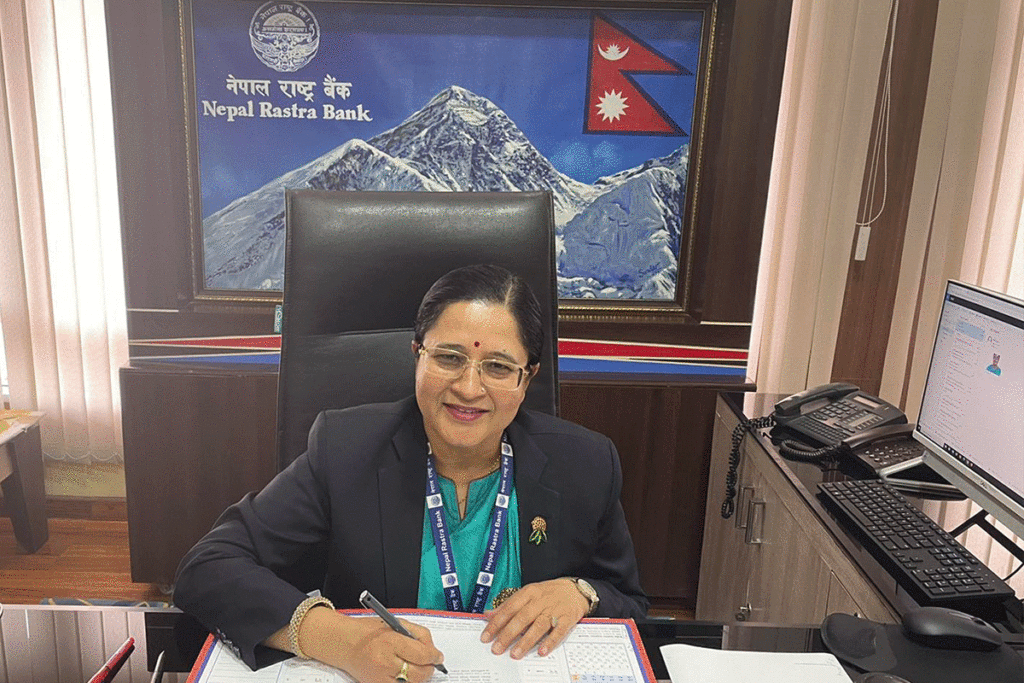

By Karuna Thapa
Kathmandu, April 11

Acting Governor of Nepal Rastra Bank Dr. Nilam Dhungana Timsina stated that there is a need to be patient for a while because the banking system is under liquidity pressure.
Dhungana, speaking at the 3rd National Microfinance Members’ Conference in Kathmandu on Monday, stated that everyone should be patient for a while because the microfinance and banking sectors are both experiencing liquidity shortages.
She stated that not just in the banking industry, but also in microfinance, there is a liquidity and interest rate problem. Governor Dhungana stated that changes in liquidity and interest rates were hurting the entire economy and individuals.
Everything will gradually improve, she continued, since the business cycle would be cyclical as well. Microfinance organizations, she noted, have been a successful instrument for reducing poverty and providing financial assistance to 20 percent of Nepal’s population.
Despite several initiatives for inclusive economic growth in Nepal, he claims that 18 percent of the country’s population remains impoverished. Microfinance institutions would definitely be an excellent instrument for poverty reduction, economic inclusion, and general economic growth, he added, with 20% of the population still without formal banking access.
She stated that microfinance has helped in the reduction of economic inequality by supporting gender-based violence and women's empowerment for the poor and target community’s economic recovery and that microfinance has enabled the poor and target community to become self-employed by providing financial access.
He stated that the banking industry is now experiencing a liquidity shortage and that
microfinance institutions are also experiencing a liquidity crunch. He also stated that there is an interest rate issue.
”It’s not only microfinance that’s damaging the economy and people,” she explained. It is not always easy to be in this situation. It is vital to be patient, as the business cycle has a cycle as well. ”The situation is bound to improve.”
Despite several initiatives for equitable economic growth in Nepal, 18 percent of the population remains poor, according to Acting Governor Dhungana. She stated that microfinance has played a significant role in reducing gender-based violence and women’s empowerment, as well as lowering economic disparity for the poor and the target community’s economic rehabilitation.