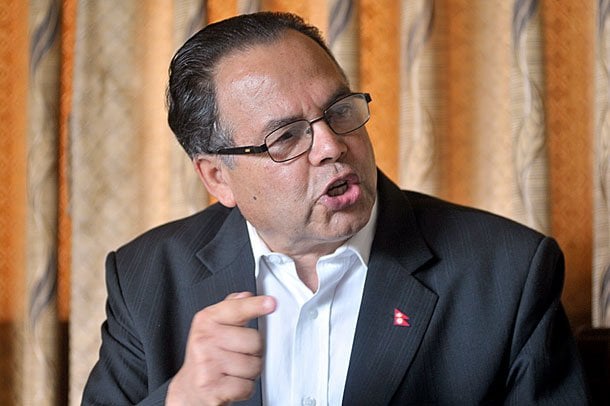

Kathmandu : Senior leader of the CPN (Unified Socialist), Jhalanath Khanal, has stood against the proposal of party unification with the Maoists. While preparations are underway to transform the Socialist Front into a single political party, Khanal has submitted a written statement to the party secretariat emphasizing the need for party reorganization instead.
Khanal is currently in India for the medical treatment of his wife, Ravilaxmi Chitrakar, who was injured during an arson attack at their residence amid the recent Gen-Z protests. In his written statement, he urged the party not to rush into celebrating unification and instead to immediately focus on reorganizing the party. He stressed that the party needs a broad-based restructuring. According to him, at a time when internal reorganization is being discussed across all political parties, it makes no sense for the Unified Socialist to play the unseasonal tune of unification. “It is necessary to reorganize the Unified Socialist broadly. The party must be restructured extensively to make it a revolutionary force. Only then will unification hold relevance,” he stated.
Khanal also remarked that when the party previously followed the Nepali Congress, it failed to build an organized movement. He argued that rushing into unification with the Maoists now would undermine the very relevance of the Unified Socialist. He clarified that he remains a supporter of broader left unity, saying, “I still stand for broad leftist unity — I have been saying so for a long time. But let everyone be aware — the time for that has not yet come.”
Furthermore, Khanal noted that the recent Gen-Z movement’s eruption was not merely an outcome of youthful impulse or a foreign conspiracy. “The explosion of the youth movement is not simply due to their emotional outburst or any external plot. It also represents the grave failure of the top leadership of the political parties that have led the country and remained in power since the dissolution of the two-thirds majority parliament,” he stated.